
Why You Should Not Read Street Smart Laws
28 Sep 2026
Procedure
27 September 2026 · 6 min read · Siddhant Pandey
What is the difference, what should you ask for, and what should you keep as proof?
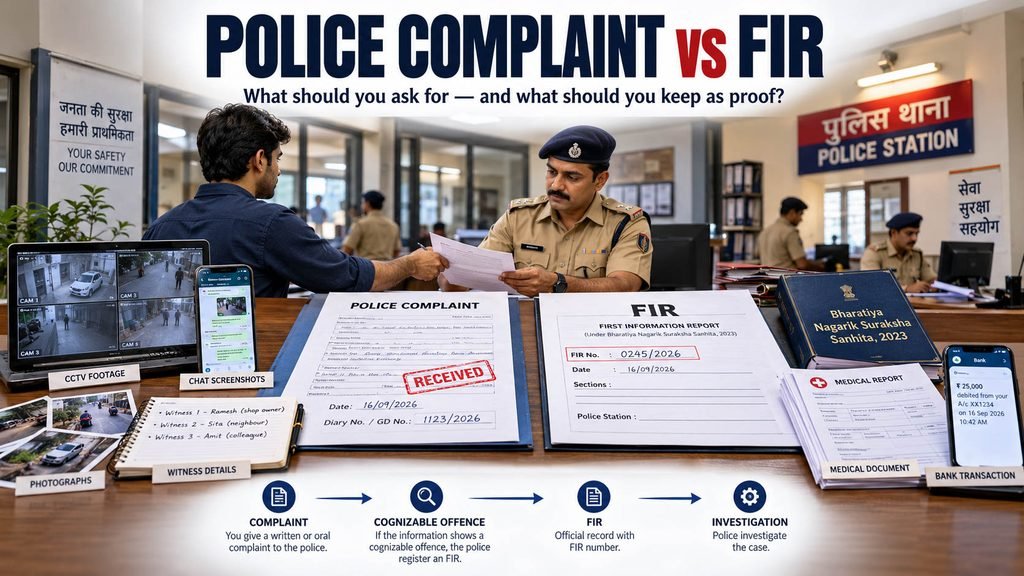
Many people use FIR and police complaint as if they mean the same thing. They do not. A police complaint is usually your written or oral intimation to the police. An FIR, or First Information Report, is the official police record made when the information shows that a cognizable offence may have taken place.
Think of it like this: complaint first, FIR next. But only if the facts disclose a cognizable offence.
This difference matters because a stamped complaint is proof that you approached the police. An FIR is proof that the police have formally recorded information about a cognizable offence and started the criminal law process.
Why This Matters in Real Life
If you go to a police station after theft, cheating, assault, stalking, cyber fraud, violence, or threats, you should know what you are leaving with.
Do not leave with only a vague promise that someone will look into it. Ask for an acknowledgement. Your complaint should ideally be stamped, signed, dated, and marked with a diary number, DD or GD entry number, complaint number, or any other official receiving number used by that police station.
That small number can become very important later.
What Is a Police Complaint
In daily language, a police complaint is a written or oral submission of facts, allegations, and evidence to the police. It tells the police what happened, when it happened, where it happened, who was involved, and what proof you have.
Under the Bharatiya Nagarik Suraksha Sanhita, 2023, commonly called the BNSS, the word complaint has a narrower legal meaning when it is made to a Magistrate. Section 2(1)(h) says a complaint is an allegation made orally or in writing to a Magistrate with a view to action under the BNSS. It does not include a police report.
So, a police complaint in everyday language is not always the same as a complaint case before a Magistrate. Law enjoys making simple words wear formal clothes.
What Is an FIR
FIR means First Information Report. The BNSS does not need to use the everyday phrase FIR everywhere. The legal basis is Section 173, which deals with information given to the police about cognizable offences.
Section 173(1) says information about a cognizable offence may be given orally or by electronic communication to the officer in charge of a police station. If the information is given orally, it must be reduced to writing and read over to the informant. If it is sent electronically, it must be signed within three days.
Once the FIR is recorded, a copy must be given free of cost to the informant or victim under Section 173(2).
What Is a Cognizable Offence
A cognizable offence is one where the police can act without first getting permission from a Magistrate. BNSS Section 2(1)(g) defines it as an offence where a police officer may arrest without warrant.
Examples can include serious offences such as theft, robbery, rape, kidnapping, grievous hurt, cheating, and many forms of violence. The exact section depends on the facts.
A criminal offence is not only a private quarrel. It is treated as a wrong against society at large. That is why the State investigates and prosecutes criminal cases.
Police Complaint vs FIR at a Glance
| Point | Police Complaint | FIR |
| Basic meaning | Information or request submitted to the police. | Official record of information about a cognizable offence. |
| Who prepares it | Usually written or given by the person approaching police. | Prepared by police based on information, complaint, or their own knowledge. |
| When it happens | First step in many cases. | After the information shows a cognizable offence. |
| Proof to keep | Stamped and signed copy with DD/GD, complaint, or acknowledgement number. | FIR number and free copy for the informant or victim. |
| Legal effect | Shows that you informed the police. | Starts formal investigation powers under criminal procedure. |
What If the Police Refuse to Register an FIR
If the information discloses a cognizable offence, FIR registration is generally mandatory. In Lalita Kumari v. Government of Uttar Pradesh, the Supreme Court held that FIR registration is mandatory where information discloses a cognizable offence.
Under BNSS Section 173(4), if the police station refuses to record the information, the aggrieved person may send the substance of the information in writing and by post to the Superintendent of Police. If needed, the person may then approach the Magistrate.
For some offences punishable with three years or more but less than seven years, BNSS Section 173(3) allows a preliminary enquiry with prior permission from an officer not below the rank of Deputy Superintendent of Police, within the limits stated in the section.
Practical Examples
If your phone is stolen, give a written complaint with the phone model, IMEI number, place, time, and any CCTV or witness details. If the facts show theft, an FIR may be registered.
If someone sends you abusive messages, the police may first record a complaint and examine what offence, if any, is made out. Save screenshots, URLs, phone numbers, and timestamps.
Here is a fun legal fact. In ordinary conversation, people often use assault to mean beating someone up. Under Indian law, assault can be about making a gesture or preparation that causes another person to fear criminal force. Actually causing bodily pain is hurt, and serious injuries may be grievous hurt.
Common Mistakes People Make
• Submitting a vague complaint without dates, names, places, or evidence.
• Relying only on verbal assurances at the police station.
• Confusing a complaint number with an FIR number.
• Adding random legal sections copied from the internet instead of clearly stating facts.
• Waiting too long to collect screenshots, medical records, bank messages, CCTV details, or witness names.
What You Should Remember
A police complaint starts the process of informing the police. An FIR starts the formal investigation process for a cognizable offence.
Always keep proof of submission. Ask for a stamp, signature, date, police station name, and diary or complaint acknowledgement number.
If an FIR is registered, ask for the FIR number and your free copy if you are the informant or victim.
FAQs
Is a police complaint the same as an FIR?
No. A police complaint is information given to the police. An FIR is the formal record made when the information discloses a cognizable offence.
Can I file a complaint online?
Yes, many States allow online complaints, and BNSS Section 173 also recognises electronic communication for information about cognizable offences. A follow-up signature may be required within three days.
Do I get a free copy of the FIR?
Yes. BNSS Section 173(2) says a copy of the recorded information must be given free of cost to the informant or victim.
What if police do not register my FIR?
You may send the information in writing by post to the Superintendent of Police under BNSS Section 173(4), and if needed, approach the Magistrate.
Can the accused get a copy of the FIR?
Yes, subject to legal process and sensitive-case restrictions. The Supreme Court in Youth Bar Association of India v. Union of India gave directions on access and uploading of FIRs.
Final Word
If this helped, share it with someone who may need to deal with a police complaint or FIR. For more simple legal explainers, follow Street Smart Laws and explore the book for practical law without the courtroom headache. Check out our Instagram Reel
Disclaimer: This article is for general awareness and is not a substitute for legal advice.
Keep reading
28 Sep 2026
28 Sep 2026

28 Jul 2026
The Weekly Brief
Join 2,000+ readers. Unsubscribe anytime. Your data stays private.